
5 Things to Know Before Buying a Home in Temecula Wine Country
Temecula Wine Country is one of the most distinctive places to explore when searching for a home in Southern California. Known for its rolling hills, vineyard views, custom estates, and peaceful countryside atmosphere, this area attracts buyers looking for more space, privacy, and a lifestyle that feels different from traditional suburban living.
Whether you're searching for a luxury estate, a property with acreage, a home with room for outdoor entertaining, or simply a quieter setting, Temecula Wine Country offers a variety of possibilities. However, buying a property here requires more than falling in love with the views. Buyers should understand the property's location, ongoing costs, utilities, land-use restrictions, and potential risks before making a commitment.
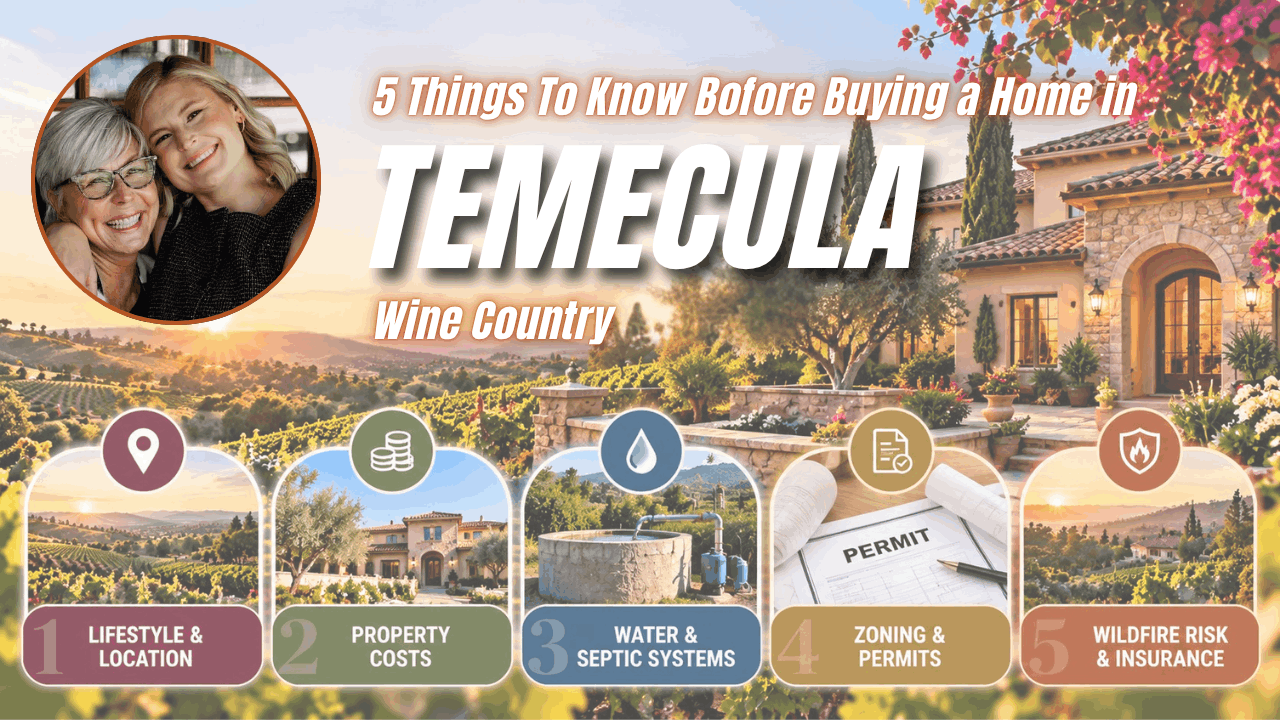
If you're considering purchasing a home in this sought-after area, here are five important things to know before you begin your search.
1. Understand the Lifestyle and Location
One of the biggest reasons buyers are drawn to Temecula Wine Country is the lifestyle. Instead of closely spaced homes and busy residential streets, many properties offer larger lots, open landscapes, scenic surroundings, and more privacy.
Depending on the location and property, you may find custom-built homes, expansive outdoor living areas, guest accommodations, equestrian facilities, or land suitable for certain agricultural uses. Some homes also offer beautiful views of vineyards, hills, and the surrounding countryside.
For buyers who enjoy entertaining, gardening, outdoor activities, or simply having more room to spread out, these features can be especially appealing.
Consider your everyday routine
Although Wine Country can feel peaceful and secluded, daily convenience should be part of your decision. Some properties are farther from grocery stores, schools, medical offices, shopping centers, and major roads than homes in central Temecula.
Before choosing a property, consider how its location will affect your daily life.
Ask yourself:
- How far is the home from your workplace or regular commute route?
- How convenient is it to reach grocery stores, restaurants, and other essentials?
- Are schools, childcare, and healthcare facilities accessible for your household?
- How comfortable are you with driving for most errands?
- Do you want to be near wineries and local attractions, or would you prefer a more secluded setting?
It's also worth visiting the area at different times. A property that feels quiet during a weekday afternoon may experience more traffic during weekends, holidays, or popular winery events.
Think about privacy versus convenience
Not every Wine Country property offers the same experience. Some homes are close to established roads and local destinations, while others are located along winding roads or long private driveways.
Consider how much privacy you want and whether the property's accessibility meets your needs. If you frequently travel, receive deliveries, or have visitors, road conditions and driveway access may become important parts of your daily routine.
Buyer tip: Create a list of your nonnegotiable lifestyle needs before touring properties. This can help you distinguish between a home that looks beautiful and one that genuinely fits the way you want to live.
2. Look Beyond the Purchase Price and Understand the True Cost of Ownership
A home's asking price is only one part of the financial picture. In Temecula Wine Country, some properties have additional expenses associated with acreage, private infrastructure, landscaping, and specialized features.
A larger property may offer more freedom and outdoor space, but it can also require more time, money, and maintenance than a traditional suburban home.
Budget for property maintenance
Depending on the home and its land, ongoing costs may include:
- Landscaping and groundskeeping: Larger lots may require regular mowing, trimming, irrigation, tree care, and vegetation management.
- Private road maintenance: Some properties rely on private roads or shared access routes that require upkeep or cost-sharing agreements.
- Water systems: Properties with private wells or extensive irrigation may have additional operating, testing, and maintenance costs.
- Septic systems: Homes without public sewer connections may require inspections, pumping, repairs, and eventual system replacement.
- Propane and other utilities: Some rural properties may use propane or have utility arrangements different from those in established neighborhoods.
- Pools and outdoor amenities: Pools, outdoor kitchens, guest houses, barns, and other features can increase maintenance and repair expenses.
These costs vary considerably by property. A home with a well-maintained landscape and reliable infrastructure may have very different expenses from one that needs significant repairs or improvements.
Review property taxes and insurance
Property taxes should be included in your monthly housing estimate. If you're considering a home with acreage, custom features, or additional structures, confirm the property's assessed value and understand how applicable taxes are calculated.
Insurance is another important consideration. Depending on the property's location, construction, condition, and wildfire exposure, homeowners insurance may be more expensive or harder to obtain than expected.
Before your inspection period ends, obtain insurance quotes for the specific address and ask about coverage limits, deductibles, exclusions, and any additional requirements.
Estimate your complete monthly budget
Instead of evaluating affordability based only on the mortgage payment, consider the full picture:
|
Expense |
What to review |
|
Mortgage |
Principal, interest, and loan terms |
|
Property taxes |
Current taxes and potential changes |
|
Homeowners insurance |
Premiums, deductibles, and coverage |
|
Utilities |
Electricity, water, gas, propane, and internet |
|
Property maintenance |
Landscaping, repairs, and equipment |
|
Private systems |
Well, septic, road, or irrigation expenses |
|
Special features |
Pool, guest house, barn, or other structures |
Buyer tip: Ask the seller for available utility bills, maintenance records, and information about recurring expenses. These records can help you build a more realistic budget before committing to the purchase.
3. Check the Water Supply, Septic System, and Other Utilities
One important difference between some Wine Country properties and homes in established subdivisions is the type of infrastructure serving the property.
Depending on the exact location, a home may connect to a public water provider or rely on a private well. Some properties have public sewer access, while others use an onsite septic system. Utility arrangements should always be verified for the individual property rather than assumed based on its location.
These systems can affect operating costs, maintenance responsibilities, and the feasibility of future improvements.
If the property has a private well
A private well can provide water to a property, but buyers should understand the condition and capacity of the system.
Ask whether recent water-quality testing is available and arrange for appropriate testing as part of your due diligence. Depending on the property, you may also want to investigate the well's flow rate, equipment condition, maintenance history, and any applicable water-use requirements.
If you plan to maintain extensive landscaping, grow crops, or operate irrigation systems, make sure the water supply is suitable for your intended use. Do not assume that a well can support every future project simply because it currently serves the home.
If the property has a septic system
A septic system requires proper maintenance and can involve substantial costs if repairs or replacement become necessary.
Before purchasing, consider arranging a septic inspection through a qualified professional. Review available records for pumping, maintenance, repairs, and permits. Ask whether the system's design and capacity are appropriate for the existing home and your household's needs.
If you hope to add bedrooms, build an accessory dwelling unit, or expand the property, investigate whether the existing septic system can support those changes. Additional approvals or system upgrades may be required.
Confirm electricity, gas, and internet access
Utility access is especially important if you work remotely or rely on consistent connectivity.
Confirm how the property receives electricity and whether there are any known service limitations. Ask which internet providers serve the address and verify the available connection type and speeds directly with the provider.
If the home uses propane, ask about tank ownership, delivery arrangements, and typical consumption. If the property has a backup generator, solar panels, batteries, or other energy systems, review their condition, ownership, permits, and operating requirements.
Buyer tip: Have the relevant systems evaluated during your inspection period. A beautiful home can become a costly purchase if essential infrastructure is outdated, undersized, or in need of major repairs.
4. Verify Zoning, Permits, and Property Restrictions Before Making Plans
One of the biggest attractions of buying in Temecula Wine Country is the possibility of having more land and flexibility. However, a large lot does not automatically mean you can use it for any purpose you choose.
Zoning rules, building codes, recorded restrictions, easements, and permit requirements can affect what you can build or operate on a property.
This is particularly important for buyers interested in agricultural activities, horses, guest houses, workshops, home-based businesses, or event-related uses.
Confirm what you can legally do with the property
Before making an offer - or at minimum before your due diligence period expires - identify your intended use and verify whether it is permitted.
For example, if you want to keep horses, ask about applicable land-use requirements and any limitations on the number or type of animals. If you're considering planting a vineyard, investigate water availability, permitted agricultural activities, and any relevant land-use requirements.
If you want to build a detached guest house, expand the existing home, install a large workshop, or add another structure, verify setbacks, building requirements, utility capacity, and permit requirements.
Do not rely solely on the property's listing description or statements that a particular use should be possible.
Investigate existing structures and improvements
A property may include a detached garage, guest house, barn, pool, outdoor kitchen, or other improvements. These features can add value and functionality, but buyers should confirm their condition and permitting status.
Request available permits and supporting documentation for significant structures and improvements. If records are missing or unclear, consult the appropriate local authority or a qualified professional about how to verify compliance.
Unpermitted work can create complications when obtaining insurance, completing future renovations, or selling the property.
Understand the property's jurisdiction
Properties described as being in Temecula Wine Country may be subject to different local requirements depending on their precise location. Some parcels are within the City of Temecula, while others may fall under Riverside County jurisdiction.
Start by confirming the property's jurisdiction, zoning designation, and applicable land-use rules. You can begin with the City of Temecula's zoning information and determine whether the city or county is the appropriate authority for the specific parcel.
Also review any homeowners association requirements, recorded easements, private road agreements, and other restrictions that may affect how you use the land.
Buyer tip: Write down your plans for the property before you tour homes. A property that suits your immediate needs may not be the right fit if your long-term goals depend on a use that is not permitted.
5. Consider Wildfire Risk, Insurance, and Emergency Access
Temecula Wine Country's natural surroundings are a major part of its appeal. However, buyers should evaluate wildfire exposure and emergency preparedness as part of their property research.
Risk can vary significantly depending on the property's location, surrounding vegetation, access roads, construction materials, and proximity to emergency services. It is important to assess the individual property rather than make assumptions about the entire area.
Research insurance availability early
Homeowners insurance should be investigated before you become too far along in the transaction.
Some properties may have higher premiums, larger deductibles, additional coverage requirements, or limited options through standard insurers. Availability and pricing can depend on factors specific to the home and its location.
Ask an insurance professional to review the actual address and explain what coverage is available. Make sure you understand the policy's exclusions and whether separate coverage may be needed for particular risks.
Do not assume that a policy covering a similar nearby property will be available on the same terms.
Evaluate the property's surroundings
During your property visit, look at the home's immediate surroundings and access.
Consider the following:
- Is vegetation maintained around the home and other structures?
- Are there trees or brush close to buildings that may need management?
- Is the driveway wide and accessible enough for emergency vehicles?
- Are there alternative routes if a road is closed?
- Are gates, private roads, or access arrangements likely to affect emergency response?
- Are smoke alarms, fire extinguishers, and other basic safety features in good condition?
Ask the seller about any known fire-related disclosures, prior damage, vegetation-management requirements, and relevant property maintenance records. A qualified inspector or appropriate local authority may help you identify additional concerns.
Plan for daily safety and connectivity
Emergency preparedness is only one part of the decision. Depending on the location, buyers may also want to verify mobile phone reception, internet reliability, street lighting, and the condition of private roads.
If you have children, older family members, or anyone in your household who needs regular medical care, consider how distance from emergency services and essential facilities could affect your routine.
Buyer tip: Review insurance options and wildfire-related concerns before your inspection period ends. Identifying potential issues early gives you more time to evaluate the risks and decide whether the property is the right choice.
Bonus Tip: Work With Professionals Who Understand the Area
Buying a property in Temecula Wine Country may involve more questions than a typical home purchase, especially when acreage, private utilities, or specialized land uses are involved.
A local real estate professional can help you compare properties, understand the transaction process, and identify questions that deserve further investigation. However, some issues require specialized advice.
Depending on the property, your due diligence team may include:
- A qualified home inspector.
- Well and water-quality professionals.
- A septic system inspector.
- An insurance professional familiar with the property's location.
- A land surveyor or other property specialist.
- A contractor or permitting professional for planned improvements.
- An attorney or other qualified adviser for complex easements, access agreements, or land-use questions.
The goal is to understand what you are buying, what responsibilities come with it, and whether the property supports your long-term plans.
Is Temecula Wine Country a Good Place to Buy a Home?
For the right buyer, Temecula Wine Country can offer a rewarding combination of scenic surroundings, privacy, outdoor living, and distinctive properties. It may appeal to buyers seeking a luxury estate, a larger lot, space for hobbies, or a quieter setting away from densely developed neighborhoods.
However, the best property is not necessarily the one with the largest lot or the most impressive views. It is the one that fits your finances, daily routine, maintenance preferences, and future plans.
Before making a decision, consider your priorities carefully. Some buyers may prefer a home close to wineries and local attractions, while others may prioritize privacy, usable acreage, or easy access to major roads. Understanding these differences can help narrow your search and make property tours more productive.
It is also important to distinguish between what a property currently offers and what you hope to do with it in the future. Confirming the condition of utilities, permitted uses, insurance availability, and maintenance requirements can help you avoid unexpected expenses and disappointments after closing.
Final Thoughts: Find the Right Home in Temecula Wine Country
Buying a home in Temecula Wine Country is about more than finding a beautiful property. It is about understanding the land, evaluating the ongoing costs, confirming what is permitted, and making sure the location suits your lifestyle.
By researching utilities, property restrictions, insurance, and maintenance requirements before committing, you can make a more informed decision and approach your home purchase with greater confidence.
Whether you're looking for a luxury estate, a home with acreage, or a peaceful retreat surrounded by scenic views, taking the time to understand each property can help you find the right fit.
Ready to explore homes in Temecula Wine Country? Contact us to discuss your goals, compare available properties, and take the next step toward finding a home that fits your lifestyle.
We’re The Hardy Group, your local realtors and community experts specializing in luxury real estate.
📱 951.465.3054
Let’s connect!
Follow us!
IG - @househardys
Website - https://askhardy.com/
YouTube - @livingintemeculavalley
Categories
Recent Posts